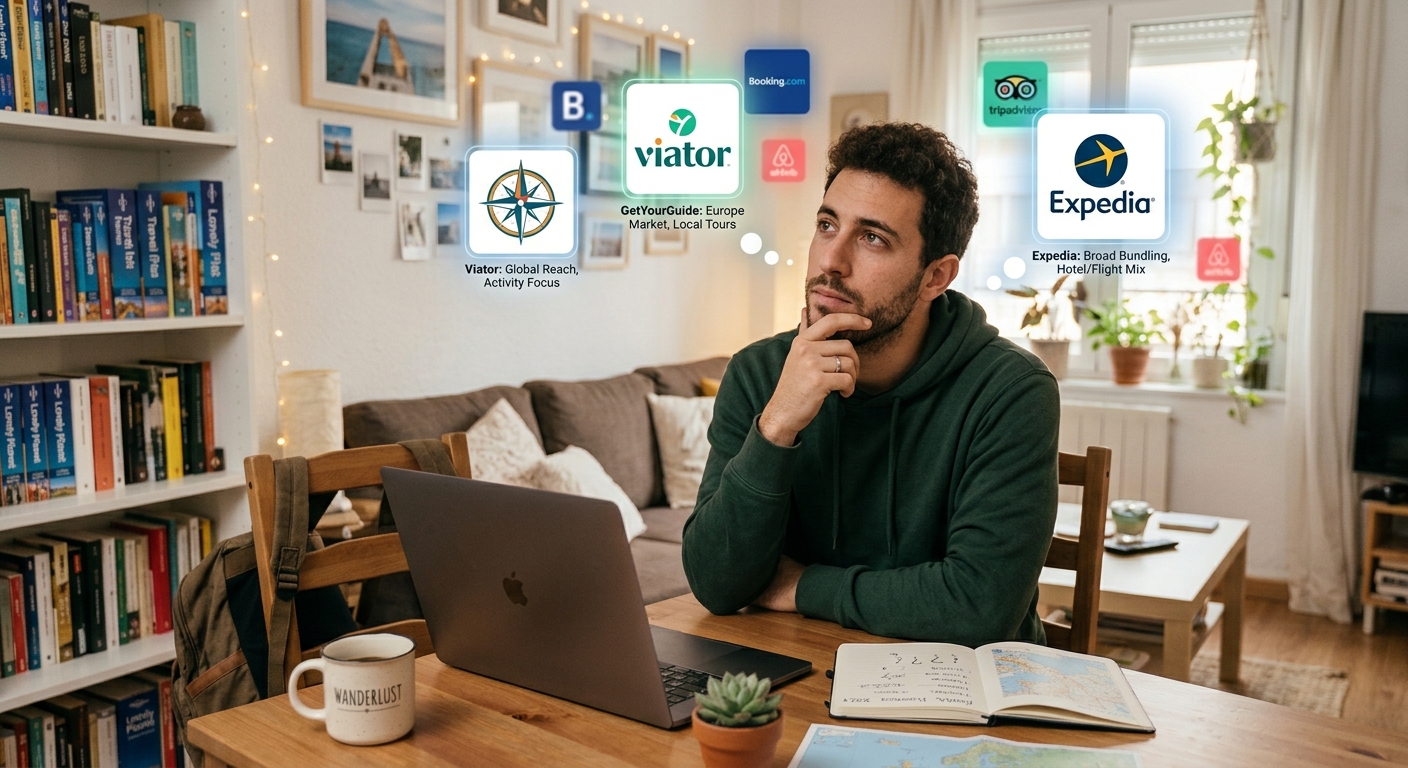
OTAs like Viator and GetYourGuide are an excellent source of customers, but relying solely on them can limit your business growth. Learn why a multi-channel strategy combined with your own booking engine can help increase direct bookings and improve profitability.
Ten years ago, being listed on platforms like Viator or GetYourGuide was considered a major achievement for many tour operators.
Today, being present on these marketplaces is almost a necessity. Millions of travelers search for tours, activities, and experiences every day, making OTAs one of the most important customer acquisition channels in the tourism industry.
But this raises an important question:
Is it a good idea to depend entirely on OTAs?
In most cases, the answer is no.
OTAs Are Excellent Customer Acquisition Channels
There is no doubt that platforms such as Viator, GetYourGuide, Klook, Headout, and Civitatis provide enormous global exposure.
These companies invest millions of dollars every year in:
- SEO
- Google Ads
- Social media advertising
- Mobile applications
- Airline and hotel partnerships
- Affiliate programs
- Brand awareness campaigns
As a result, even a small local tour operator can reach travelers from around the world without making a massive marketing investment.
For many businesses, OTAs represent the first step toward selling online.
But That Visibility Comes at a Cost
The primary business model of OTAs is based on commissions.
Depending on the destination, distribution channel, and commercial agreement, commissions can represent a significant percentage of every booking.
There is also another factor that is often overlooked:
Customers usually remember booking through the OTA—not directly with the tour operator.
As a result, the platform often owns much of the customer relationship.
OTAs Should Be an Acquisition Channel—Not Your Only Sales Channel
The fastest-growing tour operators rarely abandon OTAs.
Instead, they use them to attract new customers while simultaneously investing in their own direct booking channels.
A healthy sales strategy may look something like this:
- 40–60% OTA bookings
- 40–60% direct website bookings
- Social media bookings
- Repeat customers
- Referral business
- B2B partnerships
The ideal distribution will vary for every business, but diversification reduces risk.
Your Website Is an Investment—Not an Expense
Many operators see building a booking engine as a cost.
In reality, every direct booking can provide:
- Higher profit margins
- Complete ownership of customer relationships
- Remarketing opportunities
- Customer loyalty
- Upselling opportunities
- Less dependence on third-party platforms
Over time, these benefits can easily outweigh the initial investment.
The Customer Experience Starts on Your Website
When travelers discover your company through an OTA, many of them will visit your website before making a final decision.
At that point, they ask themselves questions such as:
- Does this company look professional?
- Is the information clear?
- Can I book directly?
- Does the booking process inspire confidence?
A slow, outdated website—or one without an online booking engine—may drive customers back to the OTA to complete their purchase.
Don't Compete with OTAs—Leverage Them
Large OTAs have marketing budgets that few independent businesses could ever match.
Rather than trying to compete against them, successful operators use them as a showcase.
OTAs generate visibility.
Your website strengthens your brand.
Social media builds trust.
Direct bookings improve profitability.
Each channel plays a different role.
Artificial Intelligence Is Changing the Rules
More travelers are now using AI-powered tools to plan their vacations.
Increasingly, AI platforms recommend tour operators, hotels, and experiences directly, often without users browsing dozens of websites.
This creates an exciting opportunity for businesses investing in:
- Helpful content
- Modern SEO
- Customer reviews
- Strong digital presence
- Well-optimized websites
As AI continues to evolve, direct bookings are likely to become even more important.
A Smart Strategy Is a Multi-Channel Strategy
The goal is not to choose between OTAs and direct bookings.
The goal is to combine both.
OTAs provide global visibility.
Your website gives you independence.
Social media builds credibility.
A professional booking engine converts visitors into customers without relying entirely on third-party marketplaces.
Final Thoughts
OTAs will remain one of the most important sales channels in the travel industry for many years to come.
However, the operators achieving long-term, sustainable growth usually have one thing in common:
They do not depend on a single source of bookings.
Instead, they build a strategy where OTAs attract new travelers, while their own website, brand, and technology transform those opportunities into lasting customer relationships.
In an increasingly competitive tourism industry, success is not about choosing one channel over another—it is about making every channel work together.